Einstein's Clocks
Einstein's Clocks
OR
A Flight Of Imagination
That Revealed The Real World
In 1905
About Einstein's thought experiments
and his ability to imagine in the moment
In 1905
About Einstein's thought experiments
and his ability to imagine in the moment
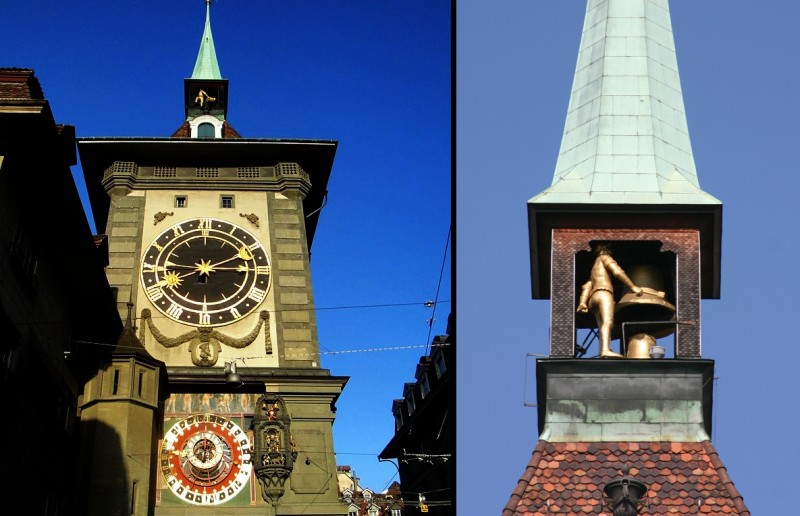
Left: Full shot of the Zytglogge tower in Bern Switzerland,
with the astronomical clock on the bottom and the bell at the top in the tower
Right: Close-up of the bell and bell ringer in the tower

Full shot of the astronomical clock (left) with the animated figures (right)
that parade and move every hour, known as the Zytglogge bellworks

Close-up of the hour hand and Zodiac wheel

Father Time sits next to the astronomical clock
and presides over the animated figures who parade every hour

A sketch of the Zytglogge tower and clock from 1534

A figure representing Chronos, the Greek god of time,
who strikes the bell, that was cast in 1405, on the hour
who strikes the bell, that was cast in 1405, on the hour

A shaft of light
Late one night
after struggling with the physics of light,
Albert heard the distinctive ring
of Bern's Zytglogge clock tower,
with its 500 year-old bell
struck by a figure
representing Chronos, the Greek god of time.
In a flash
he was riding a streetcar
at the speed of light
and looking back at the time
on the Bern clock
on the Bern clock
which froze
because the light from its later time
could never catch him.
because the light from its later time
could never catch him.
Yet he could see the minutes
on his pocket watch were
on his pocket watch were
continuing.
And then he knew
time was relative.

A streetcar with the clock behind it
around the time Einstein lived in Bern

Bern streetcar around the time Einstein lived there

Streetcar interior

Left: Inner workings of a pocket watch
Right: A Swiss pocket watch made around 1900 with Roman numerals
The man who arrives at the doors of artistic creation with none of the madness of the Muses would be convinced that technical ability alone was enough to make an artist... what that man creates by means of reason will pale before the art of inspired beings.
Plato
There comes a point where the mind takes a leap
— call it intuition or what you will —
and comes out upon a higher plane of knowledge,
but can never prove how it got there.
All great discoveries have involved such a leap.
Albert Einstein


